
ICSI technique (Intracytoplasmic Sperm Injection)
Intracytoplasmic Sperm Injection (ICSI) is an advanced assisted reproduction technique designed to overcome severe fertility challenges, particularly those related to male factor infertility.
At Gaia Fertility, ICSI is performed using state-of-the-art laboratory technology and highly specialised embryology expertise. Every stage of the process is carefully managed to maximise the chances of successful fertilisation while providing patients with confidence, reassurance, and personalised support throughout their fertility journey.
What Is ICSI?
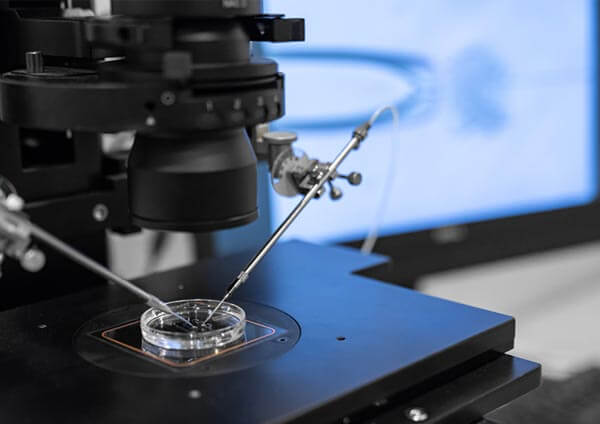
ICSI (Intracytoplasmic Sperm Injection) is a specialised IVF technique in which a single sperm cell is carefully injected directly into an egg using highly precise micromanipulation equipment.
Unlike conventional IVF, where sperm must fertilise the egg naturally in the laboratory, ICSI bypasses many of the barriers that can prevent fertilisation from occurring. By directly introducing a selected sperm into the egg, ICSI can improve fertilisation rates in cases where complex fertility factors are present.
What Is the Difference Between Conventional IVF and ICSI?
Both conventional IVF and ICSI are forms of in vitro fertilisation, but the way fertilisation takes place differs significantly.
- In conventional IVF, eggs and sperm are placed together in the laboratory, allowing fertilisation to occur naturally.
- In ICSI, an embryologist carefully selects a single sperm cell and injects it directly into the egg.
ICSI is not necessarily the best option for every patient. However, it is often the most appropriate approach when significant male factor infertility is present or when specific clinical circumstances require a more targeted fertilisation technique.
When Is ICSI Recommended?
ICSI is particularly recommended when there is a condition that may reduce or prevent natural fertilisation. At Gaia Fertility Clinic, ICSI is commonly recommended in the following situations:

When the sperm count is low.

Reduced sperm motility

Significant abnormalities in sperm morphology.

Ejaculatory disorders, including retrograde ejaculation or neurological causes.

Use of frozen sperm samples, including fertility preservation before cancer treatment or following vasectomy.

Surgical sperm retrieval procedures such as TESA (Testicular Sperm Aspiration) or PESA (Percutaneous Epididymal Sperm Aspiration).

Previous fertilisation failure during conventional IVF treatment.
The ICSI Process Step by Step
Ovarian Stimulation and Egg Retrieval: Treatment begins with a personalised ovarian stimulation protocol designed to obtain multiple mature, high-quality eggs. Throughout the stimulation phase, progress is monitored through regular ultrasound scans and hormone testing until the follicles reach the appropriate stage for egg retrieval. Once ready, the eggs are collected through a minimally invasive egg retrieval procedure performed under sedation.
Advanced Sperm Selection: In the laboratory, embryologists carefully select the most suitable sperm cells using advanced sperm preparation techniques. The selection process focuses on identifying sperm with the best motility and morphological characteristics in order to optimise fertilisation outcomes.
Intracytoplasmic Sperm Injection: Each mature egg is fertilised individually by injecting a single selected sperm directly into the egg using an extremely fine microinjection needle. This stage requires exceptional precision, specialised equipment, and extensive embryology expertise. Every injection is performed under high-powered microscopy to ensure the highest possible standards of laboratory care.
Embryo Culture and Development: Following fertilisation, embryos are cultured in advanced incubator systems that provide optimal conditions for development.
At Gaia Fertility Clinic, we use state-of-the-art technologies such as EmbryoScope, which allows continuous embryo monitoring throughout development without disturbing the culture environment. Embryos are typically cultured for 5–6 days until they reach the blastocyst stage, enabling embryologists to assess development and assess embryo development and identify those with the greatest developmental potential.
Frequently Asked Questions About ICSI
Yes. ICSI has been widely used in assisted reproduction for several decades and is considered a safe and well-established fertility treatment.
ICSI has been widely used in assisted reproduction for several decades and is considered a safe and well-established fertility treatment when clinically indicated and performed by experienced embryology teams.
As with any fertility treatment, successful outcomes depend on appropriate patient selection, careful laboratory procedures, and the quality of both eggs and sperm.
When ICSI is clinically indicated, it can significantly improve fertilisation rates.
This is particularly true in cases involving severe male factor infertility or previous fertilisation failure during conventional IVF. However, while ICSI improves the likelihood of successful fertilisation, it does not guarantee pregnancy. Other factors continue to play an important role, including:
- Egg quality.
- Embryo quality.
- Endometrial receptivity.
- Maternal age.
- Overall reproductive health.
For this reason, treatment outcomes must always be evaluated within the context of each individual patient’s fertility profile.
No. ICSI itself does not analyse or modify the genetic makeup of the embryo.
In situations where there is a known genetic risk, fertility specialists may recommend combining IVF-ICSI with Preimplantation Genetic Testing (PGT).
PGT allows embryos to be screened for specific chromosomal abnormalities or inherited genetic conditions before embryo transfer, helping to reduce the risk of transmitting certain disorders.
Book Your No-Obligation Consultation
At GAIA Fertility Clinic, we view ICSI as far more than a laboratory procedure.
It is a highly specialised fertility treatment that combines scientific precision, advanced technology, and human expertise.
Every stage of the process is carried out with exceptional attention to detail, clinical excellence, and respect for each patient’s individual circumstances.
At GAIA Fertility Clinic, we view ICSI as far more than a laboratory procedure.
It is a highly specialised fertility treatment that combines scientific precision, advanced technology, and human expertise.
Every stage of the process is carried out with exceptional attention to detail, clinical excellence, and respect for each patient’s individual circumstances.